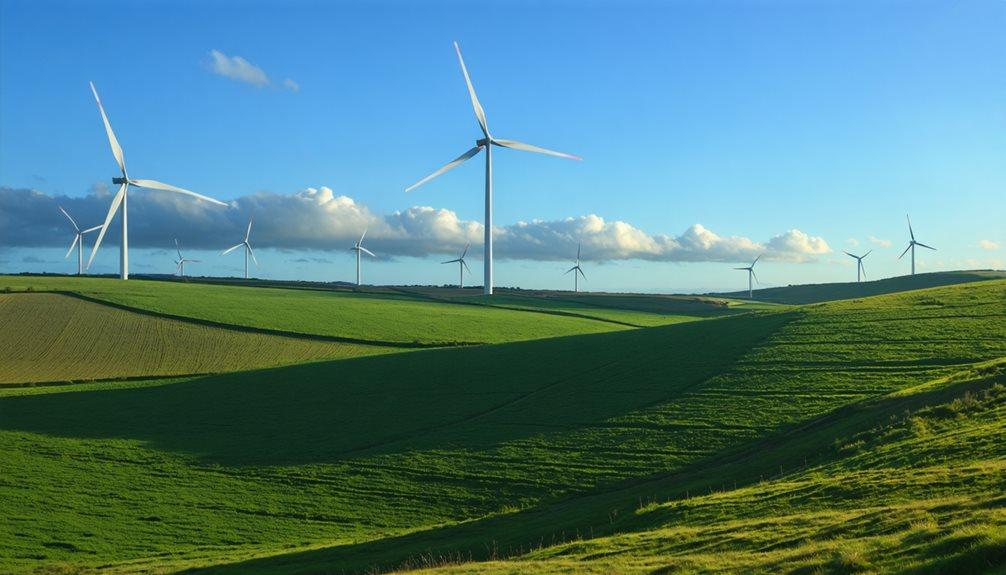
In Q1 2025, wind farms in Ireland contributed a remarkable 38% to the national electricity supply, demonstrating the success of its renewable strategies and helping reduce dependency on fossil fuels. Kerry, Cork, and Galway were pivotal, with Kerry alone producing 135 GWh. The resulting economic benefits include job creation and lowered electricity costs, with average wholesale prices dropping considerably. This transformative shift hints at even more insights about Ireland’s renewable energy advancements.
Wind energy is playing an increasingly essential role in Ireland’s electricity landscape, supplying a substantial 38% of the nation’s power in the first quarter of 2025. This significant contribution underscores the effectiveness of Ireland’s renewable investments and highlights the numerous community benefits arising from the expansion of wind energy infrastructure.
The overall electricity demand rose slightly in March, reaching 3,673 GWh, compared to the previous year. Despite a minor shortfall in wind energy’s market share, which was partially covered by solar power, the renewable sector remains pivotal in stabilizing energy prices and reducing carbon emissions.
The performance of wind farms in counties like Kerry, Cork, and Galway was instrumental, accounting for a significant portion of the national output. Kerry led the charge with 135 GWh, followed by Cork and Galway, showcasing the regional capabilities in harnessing wind potential.
The strategic placement and efficiency of these wind farms contribute not only to energy production but also to economic growth within these communities. Renewable investments in wind energy have been translated into tangible community benefits, including job creation and funding for local initiatives, further embedding these projects within the social fabric of their respective regions.
This localized energy production has also had a pronounced impact on electricity pricing trends. With the average wholesale electricity price falling to €131.80 per megawatt-hour in March, the influence of wind power on cost reduction is evident. On days of high wind activity, prices dropped even further, contrasting sharply with those reliant on fossil fuels, where prices nearly doubled.
These fluctuations highlight the financial advantages of a renewable-driven grid, reinforcing the economic case for continued investment in wind energy.
A renewable-driven grid offers financial benefits, strengthening the case for increased wind energy investment.
Looking forward, Ireland’s commitment to expanding its wind energy capacity is poised to enhance energy independence and environmental sustainability. The integration of new wind farms into the grid promises to boost community investment further, offering improved living conditions through reduced pollution and energy costs.
This strategic development aligns with Ireland’s vision for a sustainable future, driven by clean, renewable energy sources, solidifying its position as a leader in the global shift towards greener energy solutions.
Conclusion
In 2025, Ireland’s wind farms have transformed the nation’s electricity landscape, providing 38% of its energy needs and underscoring a robust shift towards renewables. March’s wind energy contribution, despite being slightly below average, alongside leaders like Kerry, Cork, and Galway, illustrates the strategic regional role in production. The resultant reduction in wholesale electricity prices highlights the dual economic and environmental benefits. As additional wind farms join the grid, Ireland’s path to energy independence and sustainable development is increasingly assured.